
Robots Race Up China's Sacred Mountain
Ninety teams tested machine endurance on Mount Tai's 3,000-step climb, with some units carrying eggs and watermelons.
By Layla Petrov ·
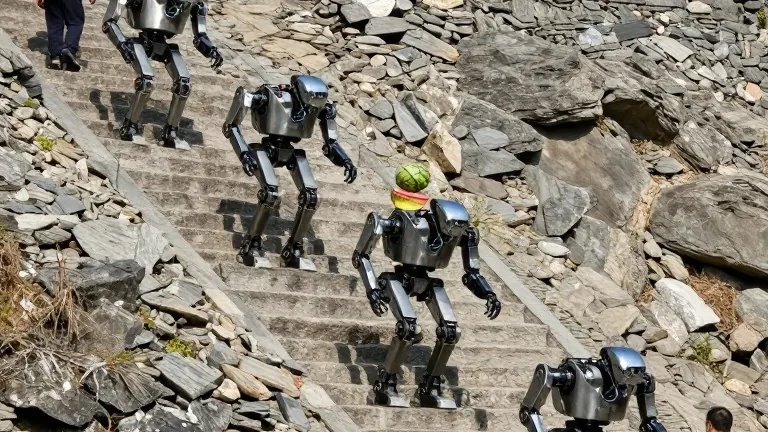
A canine robot finished a 2.4-mile climb up Mount Tai in 43 minutes and 41 seconds on Monday, beating the human average for the same route by nearly an hour.
The event, known as the World Mountain Robot Challenge, marked a shift in how engineers test machine endurance. For centuries, the peak in Shandong province served as a pilgrimage site for emperors. On Monday, state broadcaster CCTV showed dozens of robots tackling the rugged terrain, which includes more than 3,000 steps and 1,970 feet of ascent.
The race presented physical difficulties for the machines. One humanoid robot wearing a bandana collapsed on the cobbled path, requiring engineers to rush in for repairs. Another unit tumbled down a set of stairs and ended up next to a rubbish bin. Despite these setbacks, the competition continued with teams from around 90 groups entering the course.
Competitors faced two main challenges: speed and cargo transport. Teams had to complete the route as quickly as possible or deliver fragile items like fresh eggs and watermelons to the summit. The winner of the four-legged speed category was a robot made by Beijing Lingyi Technology, a subsidiary of Unitree.
The fastest humanoid robot, operated by the Beijing-based team Zhishen Lingyue, covered a shorter course in 27 minutes and 26 seconds. Local media reported that organizers view the rocky terrain as a natural testing ground for real-world applications. The state-run China Media Group arranged the event, offering cash prizes for top performers in speed and load-carrying categories.
According to CCTV, the typical tourist takes at least two hours to complete the climb. The machines finished their respective segments in a fraction of that time, demonstrating improved mechanical stability on uneven surfaces.