Serbian Politics: Student List Wins Majority
The youth-led movement secured over 50% of the vote in Sunday's election, ending a 14-year rule by President Aleksandar Vučić and his party.
By Layla Petrov ·
Belgrade, Serbia, has traditionally relied on established political hierarchies to manage its governance structure. That era concluded on Sunday when a new electoral force captured the majority of the parliamentary vote.
The Student List, a candidate group formed by a long-running youth protest movement, won more than half of all ballots cast. This result pushed the Serbian Progressive Party, led by long-serving leader Aleksandar Vučić, into second place.
Vučić conceded defeat shortly after polling stations closed. The announcement triggered immediate celebrations across the capital. Drivers honked their horns on the streets surrounding the green-domed National Assembly. Pedestrians waved and used a three-fingered salute, a gesture previously associated with nationalism that now symbolizes the Student List.
Most opposition parties withdrew their own candidates to give the Student List a clear path to victory. The new parliamentary members include academics, athletes, economists, and engineers. The group operates without a formal hierarchy or a designated leader.
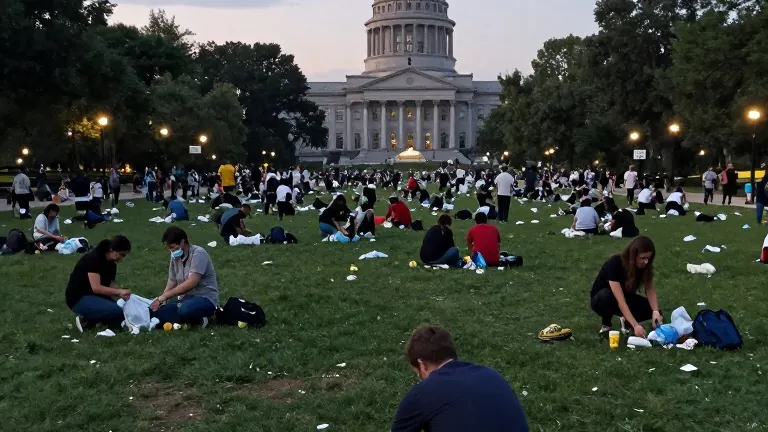
Volunteers gathered in the park opposite the National Assembly to clean up debris from a pro-government camp that had occupied the area. Radomir Delic, a volunteer picking cigarette butts from the grass, described the moment as "the smell of freedom." He noted that while the ground is covered in garbage, the atmosphere feels liberated.
Vučić governed Serbia as the dominant figure since his party took power in 2012. He held the titles of deputy prime minister, prime minister, and president. His administration maintained close ties with Russian President Vladimir Putin while simultaneously opening membership talks with the European Union. He also sought closer relations with the United States.
A controversial deal with Jared Kushner to build a Trump International Hotel on the site of buildings bombed by U.S. warplanes in 1999 led to legal issues and Kushner's withdrawal from the project. Vučić portrayed himself as a strong leader advancing the country, but his image suffered a major blow in November 2024.
A concrete canopy collapsed at a renovated railway station in Novi Sad that month, killing 16 people. The station was part of a high-speed railway line linking Belgrade and Budapest. The disaster sparked protests accusing Vučić of corruption, which led directly to the formation of the Student List.
Kurt Bassuener, co-founder of the Democratization Policy Council, warned that the broad coalition faces immediate challenges. He stated that it is far from clear who will hold specific positions in the new government. Bassuener suggested that internal fissures in the group may appear soon after the victory.
Fireworks crackled and motorbike engines revved in the hours following the vote. The Student List now holds the power to form a government in a country that had no reliable opinion polls leading up to the election.