Mid-decade redistricting backfires for Republicans in multiple states
A rare wave of mid-term map redraws aimed at securing House control failed to net new seats for the GOP in Texas, Ohio, and other states.
By Jabari Long ·
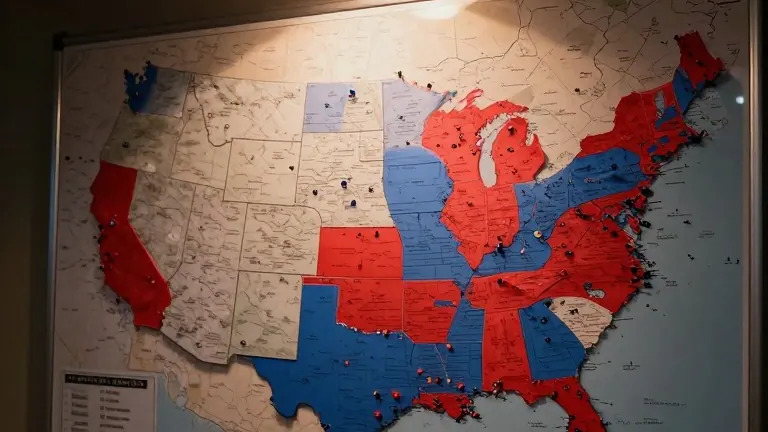
Republican-led efforts to redraw congressional maps in several states mid-decade have failed to deliver the expected seat gains. Instead, the changes have often benefited Democrats, a phenomenon analysts call a dummymander. This outcome complicates the GOP's path to maintaining control of the U.S. House of Representatives as results from Tuesday's election continue to come in.
The strategy was driven by a desire to offset demographic shifts and secure additional seats ahead of the 2028 cycle. Texas Republicans initiated the wave by redrawing their map to target South Texas, aiming for a net gain of five seats. The party held 24 seats before the election. As of Wednesday, Republicans still held 24 seats, while Democrats increased their tally from 13 to 14. The state's single vacant GOP-leaning seat did not shift the balance in the Republicans' favor.
Ohio presents a similar pattern. A commission dominated by Republicans, appointed by GOP lawmakers, redesigned the state's districts to capture two additional seats. They specifically targeted the districts of Democratic Representatives Marcy Kaptur and Greg Landsman. Heading into Election Day, Republicans controlled 10 seats and Democrats held five. Seven Democrats won on Tuesday, including Kaptur and Landsman. CBS News estimates one more district is likely to fall to Democrats, leaving Republicans with only seven victories.
In North Carolina, Republican lawmakers leveraged their veto-proof majority to redraw the map despite a Democratic governor. The plan focused on displacing Democratic Representative Don Davis. Before the election, Republicans held 10 seats and Democrats held four. By Wednesday, four Democrats had won, and CBS News projected five more districts would likely go to Democrats. Republicans had not yet claimed a victory, with one district likely GOP and four considered toss-ups.
Legal rulings in the Supreme Court regarding race-based redistricting prompted changes in Louisiana, Alabama, and Tennessee. In Louisiana, lawmakers redrew districts after a ruling on Section 2 of the Voting Rights Act. The state entered the election with four Republican seats and two Democratic seats. The new map shifted representation, with Republicans winning three districts and Democrats winning one. One district is a toss-up, and the 5th District is heading to a runoff.
Alabama and Tennessee also redrew their maps following the same Supreme Court decision. In Alabama, both Democratic incumbents won reelection, leaving Republicans with their existing five seats. In Tennessee, the new map targeted the lone Democratic district in Nashville. Republicans entered the election with eight seats and Democrats with one. By Wednesday, Republicans had won six seats, with two races, including the new 9th District, headed to runoffs.
Florida saw a redistricting effort led by Governor Ron DeSantis aimed at gaining up to four seats. Republicans started with 20 seats and Democrats with eight. As of Wednesday, Republicans had secured 16 seats, Democrats had seven, and five districts were toss-ups. In Missouri, a new map designed to favor Republicans was blocked by a state court, which required voter approval. The Supreme Court intervened three times, forcing the use of the 2022 boundaries. Democrats flipped one additional seat, moving from two to three.
Indiana and South Carolina saw attempts to eliminate their Democratic delegations fail to materialize. In Indiana, despite pressure to pass a map that would result in a 9-0 Republican delegation, the legislature did not adopt the new boundaries. Democrats retained their two seats and flipped a third, resulting in a 6-3 split. In South Carolina, Republicans sought to unseat Representative Jim Clyburn to achieve a 7-0 delegation. Clyburn won reelection, and two other races remain close.
California and Utah offer contrasting results. California’s Democratic-led redistricting measure passed, aiming to gain five seats. Democrats started with 43 districts and Republicans with nine. By Wednesday, Democrats had won 42 districts, with CBS News estimating six more were likely Democratic. Republicans won two, with two more likely GOP. In Utah, a court rejected a Republican-favored map and selected a new one that created a Democratic-leaning district in Salt Lake City. Democrat Ben McAdams won the 1st District by 47 points.
Virginia and Maryland also adjusted their maps. Virginia’s ballot measure to favor Democrats in 10 districts was defeated, reinstating the 2021 map. Democrats won seven seats, Republicans won two, and two races are toss-ups. In Maryland, Democratic Governor Wes Moore championed a ballot initiative, Question 3, to remove compactness requirements for districts. The measure passed, allowing Democrats to redraw the map to target their sole Republican representative.