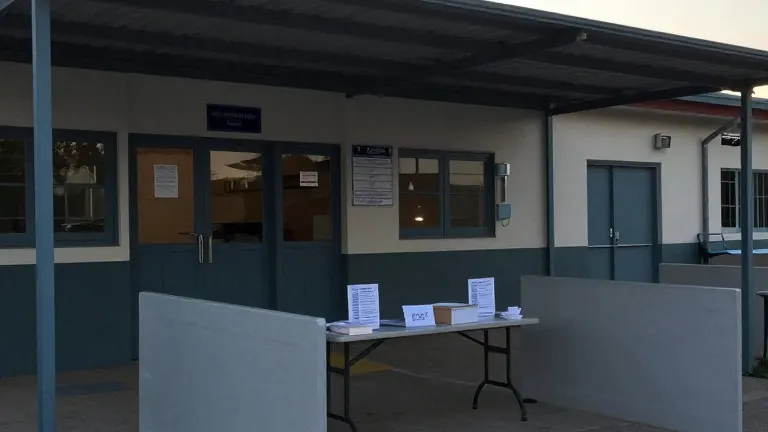
Villagers Scale Mountain to Halt Settlement Setup in Galilee
Israeli election voters head to polls Tuesday after a weeklong protest removed settler tents from a hilltop above Majd al-Krum.
By Jabari Long ·
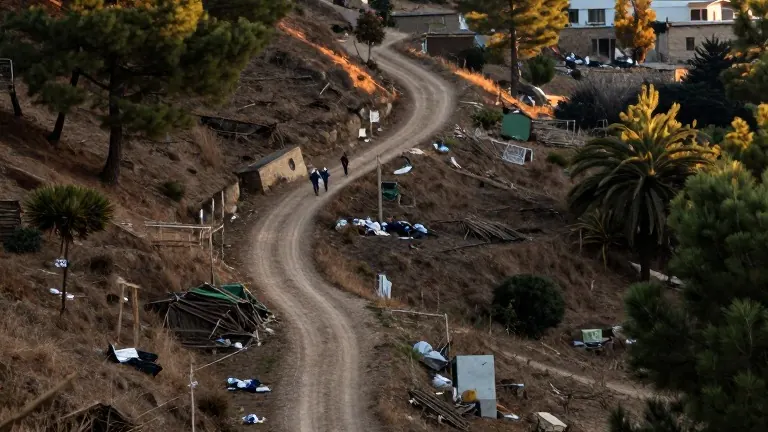
Residents of Majd al-Krum began climbing the steep trail to the pine-covered hill on September 13 after police blocked the road to al-Rus. Local Palestinian citizens of Israel traveled by horse, off-road vehicle and on foot to reach the site, where settlers from the occupied West Bank had begun building an outpost weeks earlier on village land.
Settlers said they held a Jewish National Fund permit to graze livestock there, though Hussein Mannaa, a 50-year-old lawyer with the town's Popular Committee, noted no animals were present. Within a week the camp had grown from a handful of people to between 25 and 30, according to villagers, and included a kitchen, toilet, water line and electricity. Police closed the road, but residents kept arriving. Anas Sgaier, a 21-year-old law student, described making the nearly hourlong climb and watching an woman in her 80s walk 50 minutes uphill with her husband to show her presence.
Hundreds of Palestinians from Majd al-Krum and surrounding areas such as Deir al-Asad, al-Bi'na, Sakhnin and Arrabeh protested daily for close to a week. The JNF ordered the settler tents removed, and the site was cleared by September 16. The Popular Committee met as soon as rumors of the outpost were confirmed and, with the local council, called daily demonstrations. Sgaier promoted the protests in Instagram posts, writing, "We're only going up to drink coffee, because that's our land."
Finance Minister Bezalel Smotrich campaigned on a pledge to "Judaise" the Galilee, where Palestinian citizens make up a large share of the population, and said he would repeat there "the revolution we carried out in" the occupied West Bank. He posted a plan on August 27 promising one million more Jews and 40 new Jewish communities in the Galilee and al-Naqab. His party later released an AI-generated video in which a West Bank Palestinian warns a relative in the Galilee that "the Jews are coming". Sgaier said he and friends laughed at it before watching it play out at al-Rus.
Husein Khalaily, 50, an economic consultant, called al-Rus "like a pilot experiment". "He came here and said it clearly: 'I want to Judaise the Galilee,'" Khalaily said. "Back in the day, they used to say, 'we want to develop the Galilee.' Today - the language is clear." On September 18 police announced the arrest of a 32-year-old Majd al-Krum resident over alleged contact with a Lebanese agent, and Smotrich said Galilee residents were "in the atmosphere of October 6".
The roughly 8.4 dunams at al-Rus are, according to Khalaily, half privately owned by his cousin and half administered by the Israel Land Authority, which has long refused to partition the plot. The JNF later said the grazing initiative would move to another plot about 500 metres away on land villagers consider theirs, but Mannaa said the village rejects any relocation, "even one tent". Khaled Kewan, 27, a singer from the village, said, "If they break Majd al-Krum, [it's] going to happen all over the Galilee."
Israelis vote Tuesday, and whether Smotrich remains in power depends on the result. Polls suggest neither of the main Zionist blocs can reach 61 seats without support from the Arab parties. Turnout by Palestinian citizens has run between 45 and 65 percent in recent years; organisers expect 70 to 75 percent, a level last seen in 1999, while Mannaa predicted Majd al-Krum "will go past 80 percent". Khalaily, who has voted once in his life, now urges turnout at every talk he gives. Sgaier said he will still boycott. "What happened in Majd al-Krum, we solve it by going out [to] the street - not through the Knesset [parliament] and the laws," he said.
Settler tents are gone from al-Rus, leaving sparse remains and Hebrew graffiti reading "the nation of Israel lives". Villagers still walk up daily; families barbecue there and schoolchildren draw and play music. During the weeklong protests, Kewan went to a recording studio in the evenings to work on "Ibn Bladi", which includes the line, "No matter how many walls they build across my country .. I am a son of this land, a son of my own country." Al Jazeera said it had contacted the JNF, Israeli police and the Israeli Finance Ministry for comment and had not received a response.