Election Stalemate Drives Israeli Bond Yields Higher as Shekel Slides
Partial counts show no bloc securing the 61 seats needed to govern, triggering a sell-off in local assets.
By Jabari Long ·
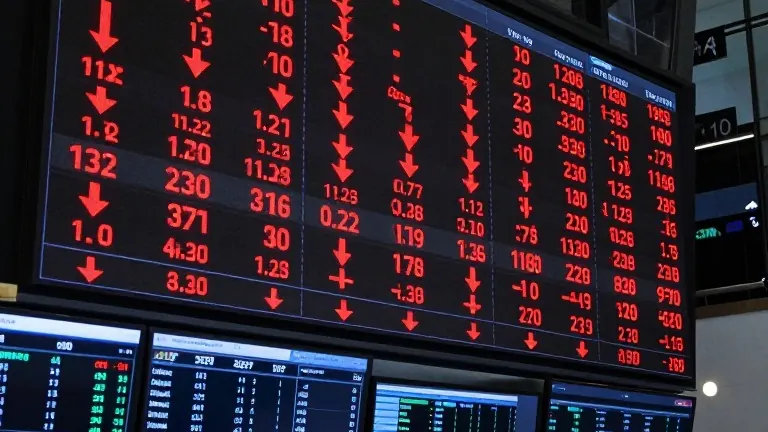
Israeli financial markets moved sharply lower on Wednesday after partial election results indicated that neither of the two major political blocs secured a governing majority. The outcome left investors uncertain about the path to a stable administration, prompting an immediate reassessment of sovereign risk. The market reaction underscores the economic cost of political fragmentation in the region.
The sell-off hit both currency and debt markets. The Israeli shekel declined by 1 percent against the U.S. dollar. In the bond market, yields rose across the maturity spectrum as prices fell. The yield on the two-year government bond increased by 6 basis points. The benchmark 10-year bond yield climbed by 4 basis points. Longer-dated 30-year yields gained 2 basis points.
Equities followed the same downward trend. The Tel Aviv 35 stock index dropped 2.7 percent during trading hours. This movement reflects investor caution regarding the upcoming government formation process. With no clear winner, the burden falls on coalition negotiations that may take weeks to resolve.
Partial results from over 66 percent of counted ballots show Prime Minister Benjamin Netanyahu's bloc projected to win 56 seats in the 120-seat Knesset. Challenger Gadi Eisenkot's bloc is projected to take 48 seats. Arab-led parties, which sit outside both main camps, are projected to hold 16 seats. Because a coalition requires 61 seats to form a government, neither leader has an automatic mandate to rule.
Eisenkot, a former military chief of staff, declared victory earlier in the day based on preliminary exit polls. He stated that the results indicate a lack of confidence in Netanyahu's leadership since October 7, 2023. The official results are scheduled for publication on November 4. Turnout reached 77.7 percent of eligible voters, the highest rate in a Knesset election in 27 years according to the Central Elections Committee.
Coalition math now favors the involvement of smaller parties. Mansour Abbas, leader of the Ra'am party, said his bloc's vote would change the government. Ahmad Tibi, chairman of the Joint List faction, outlined plans to prevent Netanyahu from remaining in power. Analysts note that Arab-led parties lean toward Eisenkot on policy issues, though neither main leader has confirmed they are willing to partner with them.
Avigdor Liberman, whose Yisrael Beytenu party is projected to win between seven and nine seats, has refused to rely on Arab parties for support. This stance adds a layer of complexity to Eisenkot's potential coalition building. Netanyahu's camp had warned of high Arab participation during the campaign, a claim that drew criticism from opponents as racially motivated.
The election served as a referendum on Netanyahu's dominance of Israeli politics since 2009. He faces a corruption trial and an International Criminal Court arrest warrant related to the Gaza campaign. If negotiations stall, another election may be called. Netanyahu has previously maintained power through such stalemates, having survived five elections between 2019 and 2022.
More Business · Watch Your Wallet · Report a business · Got a Story?